
Thomas Love Peacock
English satirical novelist and friend of Shelley.

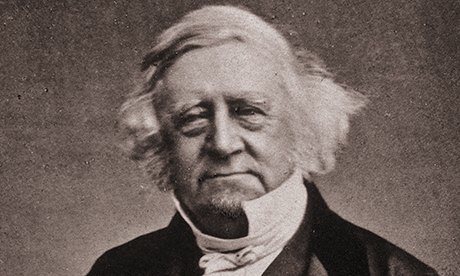
Peacock · Public domain
Thomas Love Peacock (18 October 1785 – 23 January 1866) was an English novelist, poet, and a longtime employee of the East India Company. He was a great friend of Percy Bysshe Shelley, and the two shaped each other’s writing. Peacock’s novels are satires, nearly all built around the same setup: a group of characters seated at a table, debating and taking aim at the fashionable philosophies of their time.
Peacock was born in Weymouth, Dorset, to Samuel Peacock, a London glass merchant, and Sarah Love, whose father had been a retired Royal Navy captain. After his father died in 1794, leaving the family with little money and only a small annuity, Peacock and his mother moved in with her family in Chertsey. He attended a school in Englefield Green for six and a half years, but was pulled out abruptly in 1798 at age thirteen. From then on, he taught himself entirely.
In 1800, at fourteen, Peacock became a clerk for a London merchant firm, living with his mother on the company’s premises. He won a prize from the *Monthly Preceptor* for a verse answering whether history or biography was the more improving study, and also wrote for a youth magazine that attracted other young writers like Leigh Hunt and Thomas de Quincey. He spent years studying Greek, Latin, French, and Italian literature in the British Museum’s Reading Room. He published two poetry collections, *The Monks of St. Mark* and *Palmyra*, in 1804 and 1806.
Around 1806, Peacock quit his clerk job and walked alone through Scotland. When his father’s annuity ran out that October, he returned to his mother’s house in Chertsey. A brief engagement to Fanny Faulkner was broken off by her family, and friends worried that such a clever man earned so little. In autumn 1808, he became private secretary to a naval commander, then served aboard HMS *Venerable*. He hated life at sea, calling the ship a “floating inferno” where rational work was nearly impossible, and wished he could be home writing a comedy. He did write prologues and addresses for shipboard plays, but his attempts at comedies over the next nine years were stiff and overcomplicated. He left the ship in March 1809, walked around Ramsgate, and returned to Chertsey. That year he expanded a poem about the River Thames into “The Genius of the Thames,” and in May he traced the Thames from its source to Chertsey, stopping in Oxford.
In January 1810, Peac
- born
- 18 October 1785
- died
- 23 January 1866
- field
- Novelist, poet, East India Company official
- nationality
- English
- known_for
- Satirical novels with characters discussing philosophy
Lore & Background
Peacock was born in Weymouth, Dorset, the son of Samuel Peacock and Sarah Love. His father died in 1794 leaving a small annuity, and Peacock was taken from school around 1798, thereafter self-educated. He worked as a clerk in London, won a prize from the Monthly Preceptor, and studied Greek, Latin, French, and Italian at the British Museum. He published two volumes of poetry in 1804 and 1806, and later made a solitary walking tour of Scotland.
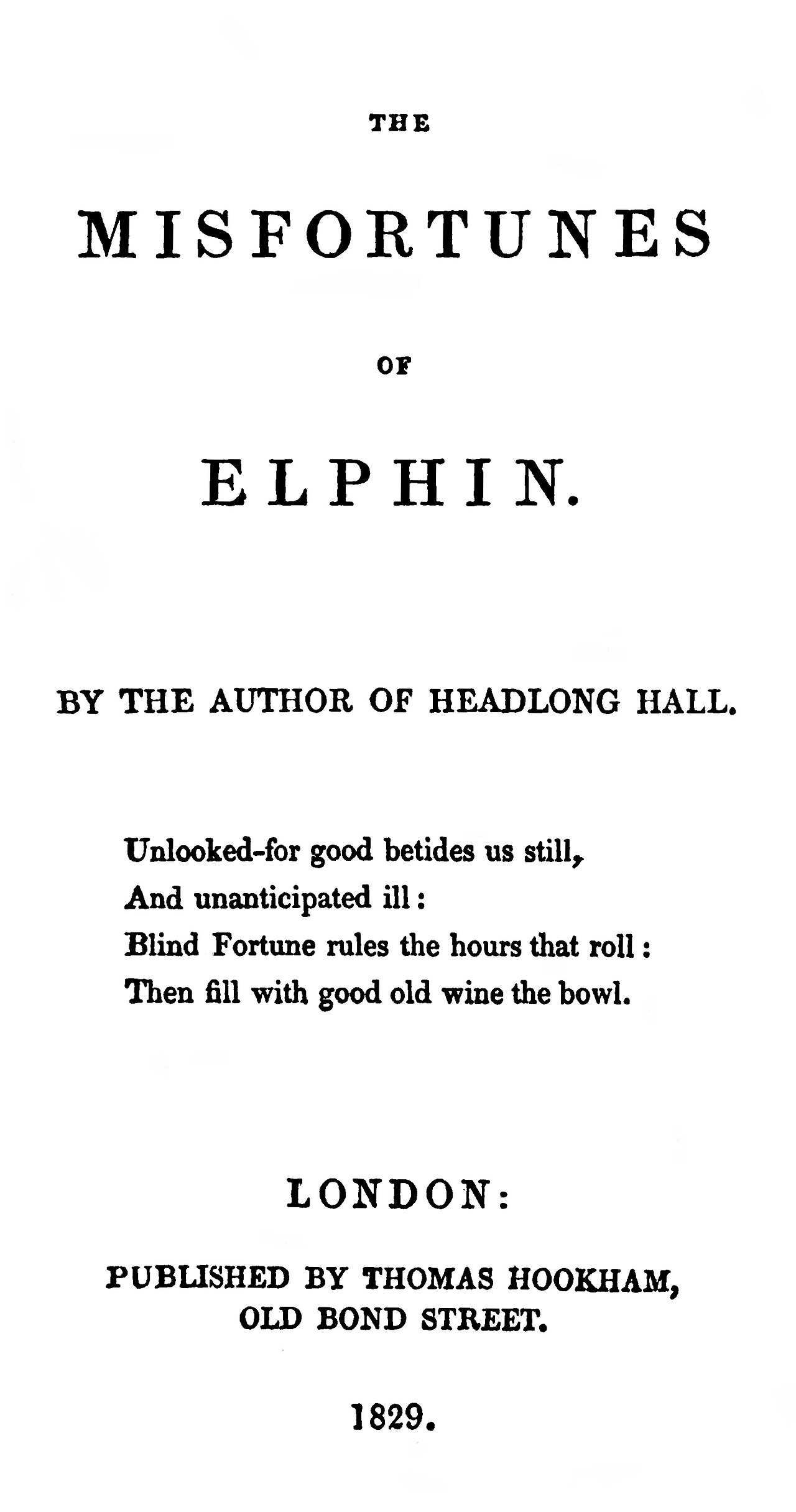
In 1812 Peacock met Percy Bysshe Shelley, beginning a close friendship. Peacock accompanied Shelley and his first wife Harriet to Edinburgh in 1813, and after Shelley deserted Harriet, Peacock visited Shelley and Mary Godwin almost daily in 1814–15. Peacock wrote his first satirical novel, Headlong Hall, in 1815, followed by Melincourt (1817) and Nightmare Abbey (1818). He also wrote the poem Rhododaphne (1818).
In early 1819, Peacock was summoned to a probationary position with the East India Company, recommended by Peter Auber, the company historian. He served as an official there for many years.
Reader's Guide
Thomas Love Peacock is significant for developing a distinctive form of satirical novel in which characters debate philosophical and social ideas, often with witty dialogue and lyrical interludes. His works, such as Headlong Hall, Melincourt, and Nightmare Abbey, critique contemporary intellectual trends while showcasing his erudition and humor. His friendship with Percy Bysshe Shelley was mutually influential: Peacock's enthusiasm for Greek poetry affected Shelley's work, and Shelley's encouragement helped shape Peacock's literary output. Peacock's later career at the East India Company, alongside James Mill, reflects his administrative abilities. His novels remain studied for their unique blend of satire, romance, and intellectual commentary, and his correspondence with Shelley preserved important literary history.
Did You Know?
- Peacock's first known poem was an epitaph for a school fellow written at age ten.
- He won the eleventh prize from the Monthly Preceptor for a verse answer to the question 'Is History or Biography the More Improving Study?'
- Peacock served briefly as private secretary to Sir Home Popham in 1808 and later aboard HMS Venerable.
- He was recommended for a position at the East India Company by Peter Auber, whom he had known at school.
Coal-Dust Roots and a Mother's Ambition
Lawrence entered the world in September 1885 in the Nottinghamshire mining village of Eastwood, the fourth child of a barely literate collier and a woman who had once taught school before financial hardship forced her into a lace factory. The friction between these two parents—the father's wish that his boys "go down pit" and the mother's fierce resolve that they should never earn a living through manual labor—became the emotional bedrock of his earliest fiction. His mother won the day for him, and young Lawrence roamed the hilly country and surviving patches of Sherwood Forest north of Eastwood, cultivating a lifelong devotion to the natural landscape he would later call "the country of my heart." At Greasley Beauvale Board School he distinguished himself as the first local child to secure a county council scholarship to Nottingham High School. The house at 8a Victoria Street where he was born now houses a small museum dedicated to his memory, a modest monument to a boy who climbed out of the coalfields through books and stubborn maternal will.
From the Classroom to the Writing Desk
Between 1902 and 1906 Lawrence served as a pupil-teacher in Eastwood, then earned a teaching certificate from University College, Nottingham in 1908, all while quietly drafting poems, short stories, and a novel he initially titled Laetitia. His first taste of wider recognition came in late 1907 when a short story won a competition in the Nottinghamshire Guardian. Moving to London in the autumn of 1908 to teach at Davidson Road School in Croydon, he continued writing in his spare hours. A turning point arrived when his friend Jessie Chambers sent some of his early verse to Ford Madox Ford at The English Review; Ford commissioned the story "Odour of Chrysanthemums," and London publisher Heinemann soon requested more. After his mother's death from cancer in 1910 shattered him into what he called a "sick year," a second bout of pneumonia in November 1911 finally freed him from the classroom. He abandoned teaching, ended an engagement to a childhood friend, and in March 1912 met Frieda Weekley, the woman who would share the rest of his life.
Censorship, Exile, and a Controversial Name
Lawrence's modernist fiction—concerned with social alienation, industrialisation, and the vitality of instinct and sexuality—provoked fierce backlash. Four of his best-known novels, Sons and Lovers (1913), The Rainbow (1915), Women in Love (1920), and Lady Chatterley's Lover (1928), along with the posthumous The Virgin and The Gypsy (1930), all faced censorship trials over their frank treatment of romance and explicit language. Throughout his life he endured persecution and the persistent misrepresentation of his work, spending much of it in what he termed a "savage enough pilgrimage" of voluntary self-exile. By the time he died in 1930, public opinion had largely branded him tasteless, an avant-garde provocateur, or simply a pornographer who had found a market for erotica. A 1908 private letter in which he endorsed eugenics through a "lethal chamber" for the sick and maimed only deepened the sense that his private views were as inflammatory as his art.
Rehabilitation and the Question of Legacy
The verdict of Lawrence's own generation was harsh, but two voices ultimately reframed how readers would remember him. E. M. Forster, writing an obituary notice after Lawrence's death in March 1930, pushed back against the prevailing scorn and called him "the greatest imaginative novelist of our generation." Later, the critic F. R. Leavis mounted a sustained defense of Lawrence's artistic integrity and moral seriousness, arguing that the sensationalism of his subject matter obscured a genuinely serious literary project. These interventions helped shift the critical consensus over the following decades. Meanwhile, quieter threads of his legacy persist: the small museum at his Eastwood birthplace, his early championing of the poet Anna Wickham, and the enduring friendship he shared with the editor Edward Garnett, who mentored him through his most formative revisions. The boy who once roamed Felley woods and called the Nottinghamshire landscape "the country of my heart" became, through a combination of personal turbulence and artistic ambition, one of the defining novelists of the twentieth century.
Gallery

Frequently Asked Questions
Who is Thomas Love Peacock?
Thomas Love Peacock (1785–1866) was an English novelist, poet, and senior civil servant at the East India Company. He is chiefly remembered for a small body of satirical novels that skewered the intellectual fashions of his day.
What is Thomas Love Peacock's signature literary technique?
Almost every one of his novels stages a small circle of characters gathered around a table, locked in extended philosophical debate. This deliberate, almost theatrical format gave him a sharp vehicle for mocking the trendy theories circulating in early nineteenth-century England.
How did Thomas Love Peacock's life end?
Peacock died on 23 January 1866 in England, having spent the last decades of his career as a senior official at the East India Company. Though he never achieved mass popularity, his satirical voice continued to attract readers of Victorian and modern literary comedy.
Why is Thomas Love Peacock important to literary history?
He occupies a distinctive niche in the English satirical tradition, using structured dialogue to dissect the philosophies of his era. His creative partnership with Percy Bysshe Shelley also makes him a vital link between Romantic poetry and early Victorian prose satire.
What was Thomas Love Peacock's relationship with Shelley?
Peacock and Shelley were intimate friends who actively sharpened each other's thinking and craft during the 1810s and 1820s. Their mutual influence is evident in how both men wrestled with the same intellectual currents, Peacock through comic prose and Shelley through lyrical verse.
More in European Literary Masters 25-35
Elsewhere in the European Literary Masters universe
Spotted an error? Know more?
This is a living reference — every entry is fact-audited, and reader corrections feed straight into our audit queue. Suggest an edit · See this site's audit record